News from Muscadet Sèvre-et-Maine: Four New Sub-zones Approved

.

.

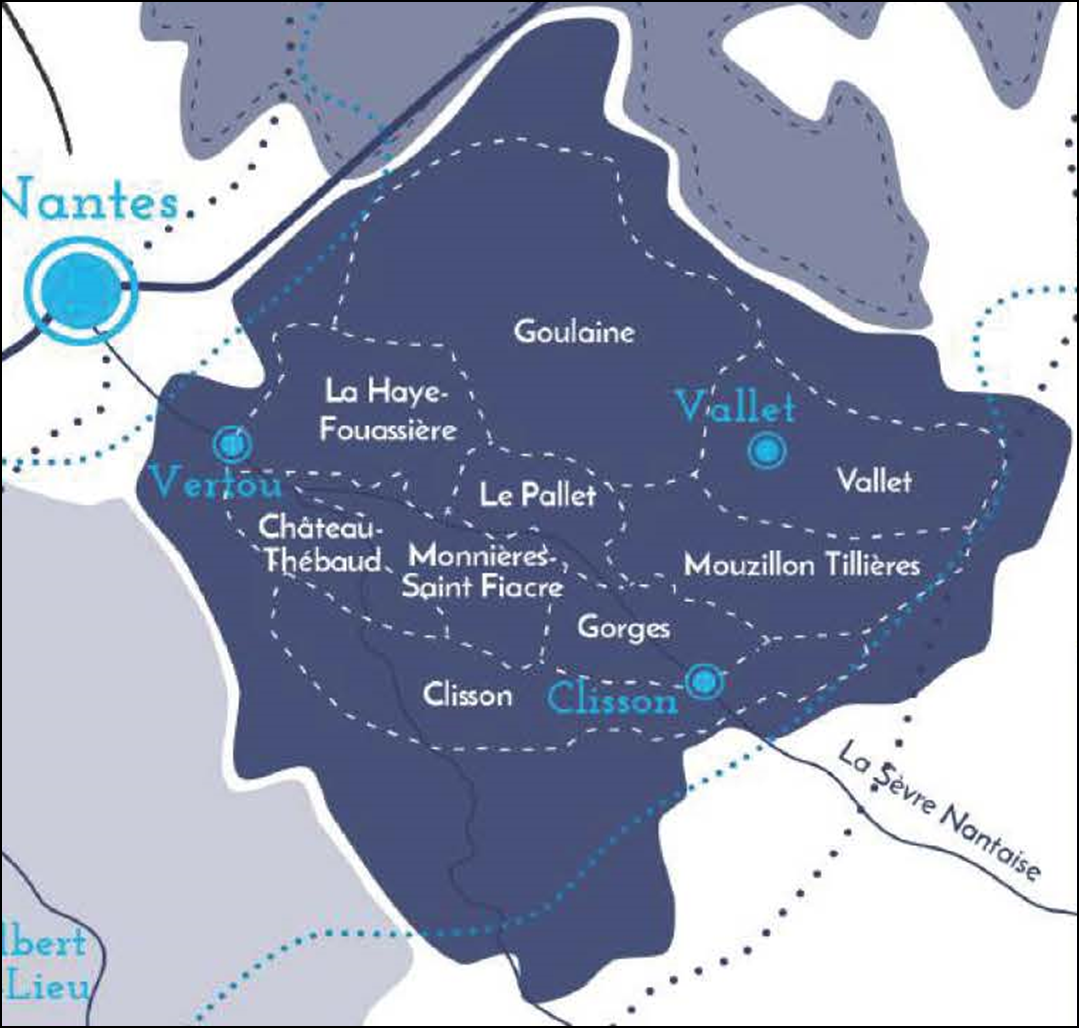
On Wednesday, June 19, 2019 France’s Institut National de l’origine et de la Qualité (INAO) approved a revision of the Cahier des Charges of the Muscadet Sèvre-et-Maine AOC and in doing so, approved four new sub-zones for the appellation. These geographical indications are sometimes referred to as Crus, or Crus Communaux (cru communal zones).

This new announcement means that the appellation now contains seven sub-zones including Clisson, Gorges, and Le Pallet (approved in 2011). These seven sub-zones represent the highest-quality wines (and very limited production) from the large and Muscadet Sèvre-et-Maine appellation.

The Muscadet Sèvre-et-Maine AOC is located in the Pays Nantais area of France’s Loire Valley, and is known for still (non-sparkling) white wines produced using 100% Melon de Bourgogne grapes. Much of the production is produced in the sur lie style, requiring that the wine be aged on the lees (expired yeast cells) until at least March 1 of the year following the harvest. (A sub-zone designation typically requires longer minimum sure lie aging times as well as other specific standards required for qualification.)
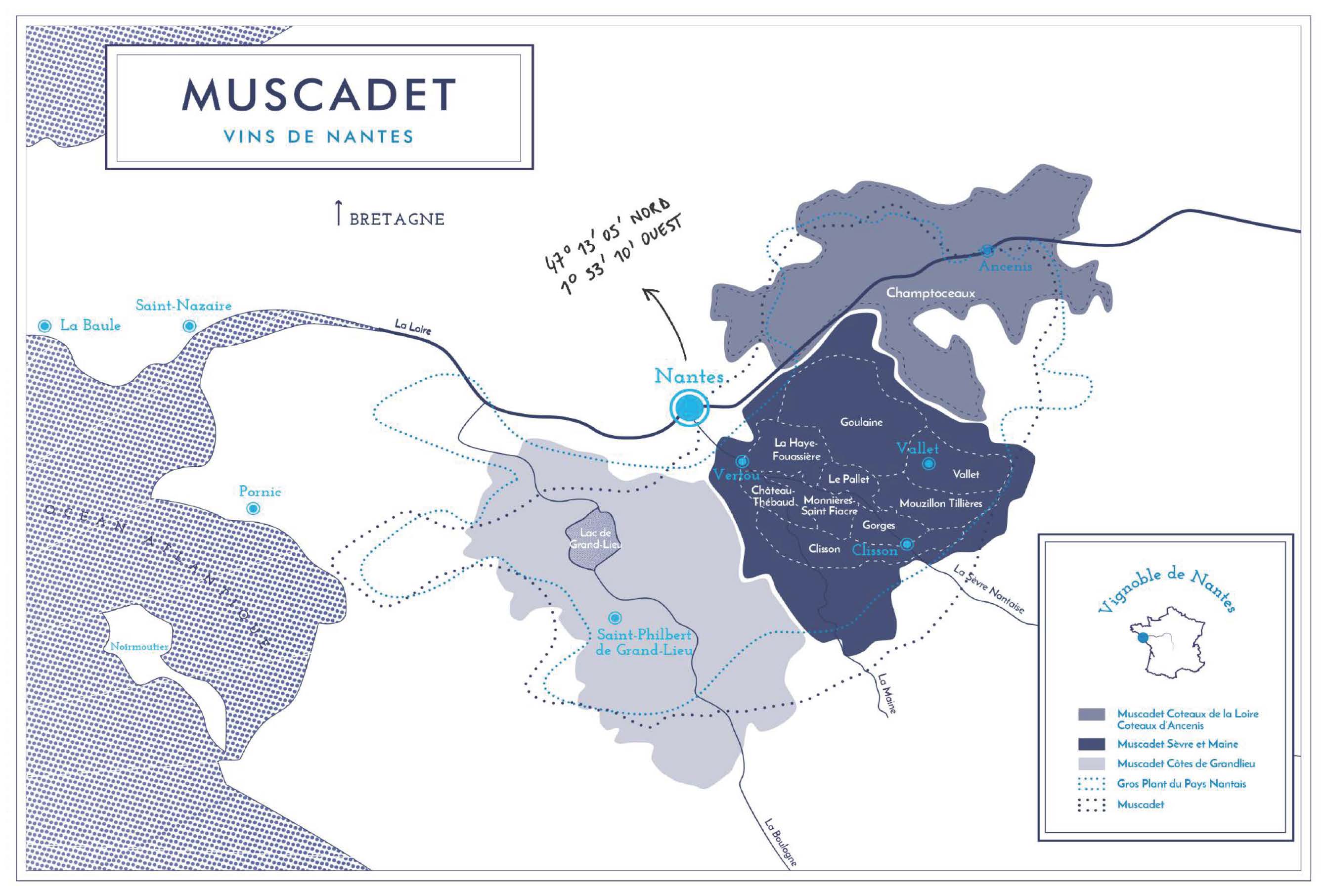
Map of Muscadet via: https://www.vinsvaldeloire.fr/en

Map of Muscadet via: https://www.vinsvaldeloire.fr/en

The new sub-zones are as follows:

Goulaine: Goulaine is the northernmost as well as the largest of the seven crus of Muscadet Sèvre-et-Maine AOC. This area is dominated by a series of small hills overlooking the Marais de Goulaine (a swampy area known as the Marsh of Goulaine). Top soils are coarse and sandy; subsoils are mainly metamorphic (gneiss and schist). Vines in the Goulaine sub-zone tend to have early bud break and are often the first vines in the area to be ready for harvest.

Château-Thébaud: The Château-Thébaud sub-zone is located in the southwest portion of the Muscadet Sèvre-et-Maine AOC, just to the north of Clisson. The area consists mainly of hills and hillsides, some of them steep and wooded. Many of the finest vineyard sites are located near the Maine River as it flows through this area in a north/northwest direction. Soils are mainly sandy/stony atop granite and gneiss.
Detail of the map of Muscadet via: https://www.vinsvaldeloire.fr/en

Detail of the map of Muscadet via: https://www.vinsvaldeloire.fr/en

Monnières-Saint-Fiacre: The Monnières-Saint-Fiacre cru—also located just to the north of the Clisson subzone—lies just to the east of Château-Thébaud. The vineyards are planted on a succession of hillsides spread over eastern bank of the River Sèvre, extending into the surrounding valleys and woods. The soils consist primarily of sandy loam over a subsoil of gneiss and some clay.

Mouzillon-Tillières: Mouzillon-Tillières is located to the north of the River Sèvre, to the north/northeast of the Gorges sub-zone. It is centered around the Sanguèze River (a 44km-/27 mile-long tributary of the Loire).  The vines are planted on a series of small hillsides and outcrops along both the sides of the river. The soils are mainly composed of sand and clay over gabbro bedrock (gabbro is an igneous rock created by the slow, underground cooling of magma).

Keep those flashcards handy: According to the website of Loire Valley Wines (Vins de Val de Loire), three more areas— La Haye-Fouassière and Vallet (in Muscadet Sèvre-et-Maine), as well as Champtoceaux (located within the Muscadet Coteaux de la Loire AOC)—are being considered for sub-zone status.

Please note that while you will be able to see these subzones on wine labels beginning with the 2018 harvest, the new-and-improved Cahier des Charges for the Muscadet Sèvre-et-Maine AOC (as linked below) will still need to wind its way through the EU registration process.

Click here for more information on Muscadet (note the details on the Clisson, Gorges, and Le Pallet sub-zones near the bottom of the page).

Post authored by Jane A. Nickles…your blog administrator: jnickles@societyofwineeducators.org

References/for more information:

Modern Vodka for Canada: Canada Updates its 60-year-old Vodka Standards

.

.

Effective today (June 26, 2019), the government of Canada has updated its labeling laws for vodka. This is the first change in the country’s laws regarding vodka since 1959. The change was announced via publication in the Canada Gazette, Part II, Volume 153, Number 13.

These new laws—as set forth in the Food and Drug Regulations of Canada—include the following standards:

  • Canadian vodka may be produced from cereal grains, potatoes, or other agricultural products such as fruit, dairy products, or honey
  • If produced from a base ingredient other than potatoes or grains, it must be stated on the label using terminology such as “vodka produced from grapes” or a phrase such as “produced from apples” in close proximity to the term “Vodka” on the label
  • Canadian vodka should be rendered neutral (without distinctive character, aroma, or taste) during its production process, which may include (but does not require) charcoal filtration.

These new standards are an update of the previous laws, which permitted Canadian Vodka to be produced using potatoes or cereal grains only, and required that all Canadian vodka undergo charcoal-filtration.

It is expected that these new laws will encourage innovation in the Canadian distilling industry while facilitating international trade.

Sounds like today is a great day to taste-test some Canadian vodka! May I recommend Crystal Head Vodka (Dan Aykroyd will thank you), Iceberg Vodka, or perhaps a dry martini made with Polar Ice?

Post authored by Jane A. Nickles…your blog administrator: jnickles@societyofwineeducators.org

References/for more information:


Nizza DOCG: Official at Last!

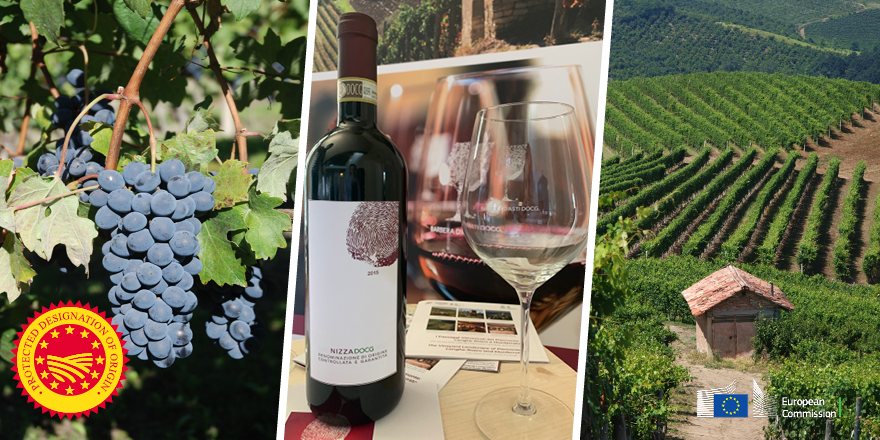
Photo via: https://ec.europa.eu/info/food-farming-fisheries

Photo via: https://ec.europa.eu/info/food-farming-fisheries

Nearly five years after its approval by Italy’s Ministry of Agriculture and its original application to the EU, the Nizza DOCG is signed, sealed, and delivered…and has received its final approval and registration as an EU-protected designation of origin (PDO) product for its Barbera-based red wines.

Click here to view the announcement in the June 12, 2019 edition of the Official Journal of the European Union.

We’ve been enjoying the deep red wines of the Nizza DOCG (produced in Piedmont, Italy) for several years now, but as a reminder, here are the rules and regulations for Nizza DOCG wines:

  • The place: All grapes must be grown within a delineated geographic zone, which was an already-established subzone of the Barbera d’Asti DOCG. The allowed communes of production include Agliano Terme, Belveglio, Calamandrana, Castel Boglione, Castelnuovo Belbo, Castelnuovo Calcea, Castel Rocchero, Cortiglione, Incisa Scapaccino, Mombaruzzo, Mombercelli, Nizza Monferrato, Vaglio Serra, Vinchio, Bruno, Rocchetta Palafea, Moasca, and San Marzano Oliveto.
  • The vines: Every vineyard destined for the Nizza DOCG must be registered with the Consortium and tout particular soils and exposures.  Vines must be entirely estate, planted on the slopes of hills facing south-east to south-west.
  • The harvest: Harvest must be done entirely by hand.
  • The grapes: 100% Barbera
  • Alcohol: Minimum 13% abv
  • Aging: Total minimum aging is 18 months from January 1 of the year following harvest. Total aging time must include at least 6 months in oak.
.

.

In addition, all wine bearing the “Nizza DOCG” designation must meet the standards set forth by the consortium for organoleptic properties and laboratory analysis. If a wine does not meet with the consortium’s approval, it may be de-classified and bear the title of Barbera d’Asti DOCG, Monferrato Rosso DOC, Piemonte Barbera DOC, or Piemonte Rosso DOC (assuming, of course, that the wine meets the standards of the individual appellation). Interestingly enough, one facet of the consortium’s laboratory analysis is a  minimum requirement of 26 g/L “dry extract.”

Welcome to the world, Nizza DOCG—or perhaps we should say “Congratulations on your promotion, Nizza DOCG!” Either way, it’s great to see Nizza get the respect it deserves!

P.S. The EU must have had a busy week, as the June 12, 2019 edition of the Official Journal of the European Union noted the official registration of three other wine appellations—we’ll have more information on this tomorrow!

Post authored by Jane A. Nickles…your blog administrator: jnickles@societyofwineeducators.org

References/for more information: